Strange Apparatus by Loren Orsillo & Untranslatables by Tieyuan (Vivian) Zhou.
Loren Orsillo
Loren Orsillo is a contemporary artist living and working on Kaurna Land. Her cross-disciplinary assemblage practice uses casting processes and readymade objects sourced from the various environments where she makes her work. Driven by a methodology that prioritises unconventional reiterations of tools, materials and objects, the artworks that emerge are wall-based, and sit somewhere between aesthetic forms and functional objects.
Loren has exhibited consistently across her career, with group exhibitions including Open Studio at ACE, and Materiality at Praxis artspace, and Eastbound at Backwoods gallery, as well as several solo exhibitions, including Monster Thrasher/Catcher Keeper: A Final Love Letter to Mr Graves at Post Office Projects. Loren is currently undertaking a PhD at Adelaide University, exploring the field of assemblage practices, due for completion in 2026.


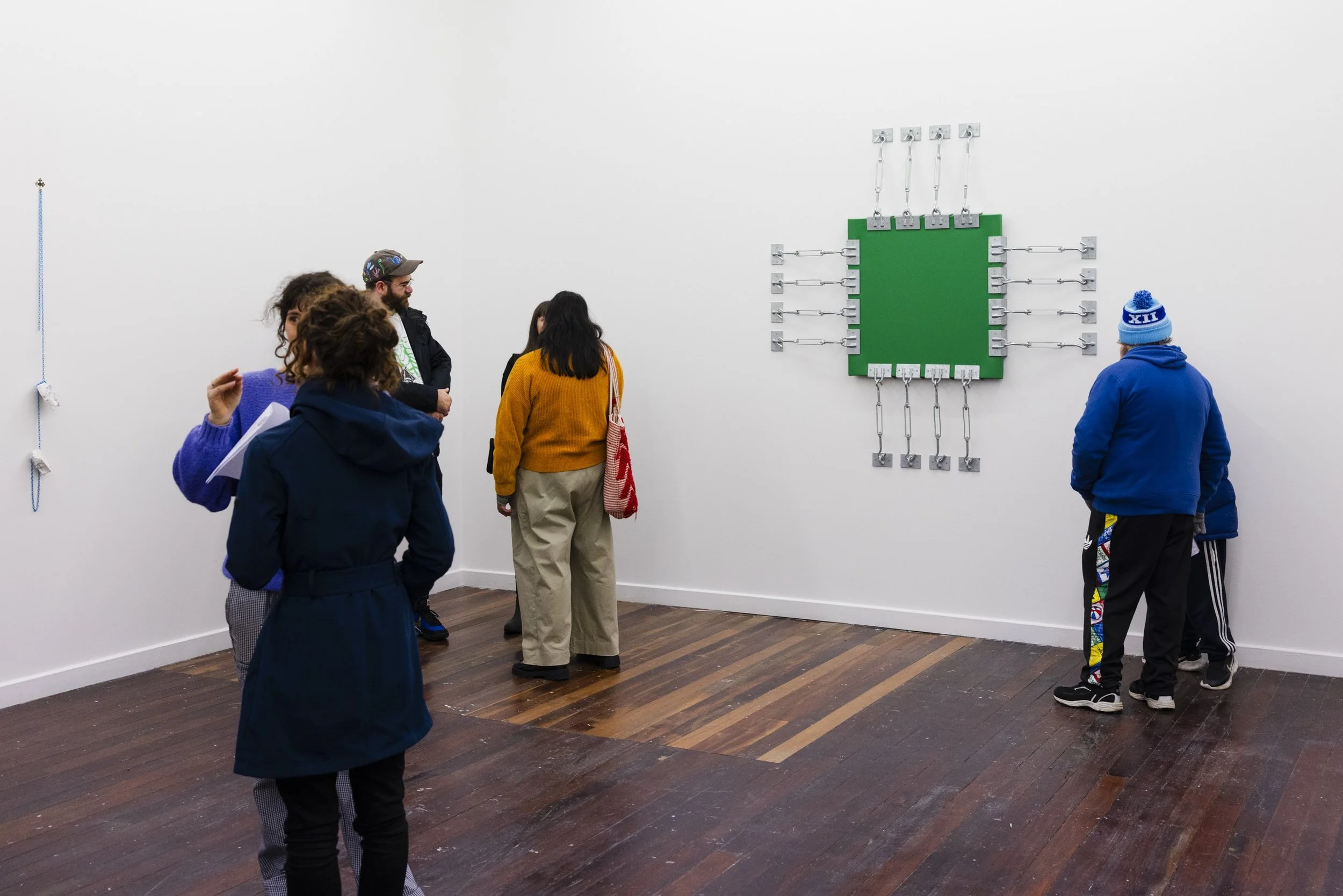
In Strange Apparatus, Loren Orsillo asks us to contemplate the hanging device as something other than invisible and functional. In her collection, the focus on nails, adhesives and hooks invites us to disrupt our conventional experience of viewing art.
Her artwork demonstrates that hanging apparatus have their own agency and meaning, separate to but simultaneously part of the artwork itself. Loren brings innocuous, practical objects (hanging apparatus) that are usually hidden and taken for granted, into the foreground, enabling them to showcase their own performative capacity.
The reveal/revelation in this collection is the close, overt ties between object and subject. There is an overlap between the work and how it is suspended, attached or hung and the viewer is asked to consider how they operate together as a whole, rather than categorise each separately.
In V4, the hooks are not just a method of attachment to the wall but part of the “monstrosity” of the piece. The hooks are hard and unyielding, demonstrating power, resilience and awesome strength. They are not just a functional component but an indelible part of the artwork. They are the dominant construct and focus, and the canvas in the middle is the actor being subjected to the action.
One of the exhibition’s goals is to generate a non-hierarchical way of looking at art and shift the viewer’s perspective and understanding of the work and their gaze upon it. It aims to reconfigure our perception of function and form and how they can be fused to create something unified.
Shield Assemblage is a demonstration of art that evolves and changes shape and perspective as it’s being viewed. It also represents the intimate conversation between art and hanging device. The viewer is forced to engage with the work in a more interactive way, observing movement and shadow as components swing freely off hook devices. This piece exemplifies ‘hanging’ in the true sense of being suspended rather than fixed.
All of Loren’s pieces show that the artwork cannot exist without both elements—the subject and the hanging device—working in harmony . She asks us to receive each work as one entity, blurring and dissolving our instinct to regard each element as distinct.
Tina Morganella
Tieyuan (Vivian) Zhou
Tieyuan (Vivian) Zhou is a multidisciplinary artist based in South Australia, working across ceramics, printmaking, installation, and mixed media. Her practice engages with memory, migration, and cultural identity through materially driven processes and quiet, poetic forms. Born in China and migrating to Australia in 2013, Zhou’s work is shaped by experiences of linguistic translation and cultural displacement, as well as ongoing processes of rebuilding across contexts.
Zhou holds First Class Honours in Contemporary Art from the University of South Australia. Her research-led practice has been recognised with the Major Exhibition Award and the Jaquillard Exhibition Award at the 2025 Helpmann Academy Graduate Exhibition. In 2025, she participated in the Stobie Pole Project, her first public art commission, extending her studio-based inquiry into an urban and civic context. In 2026, she presented a solo exhibition at Linden New Art Gallery in Melbourne (28 May – 28 June), under the mentorship of Dr. Vincent Alessi, further developing her engagement with fragile material systems and spatial translation.
Working between academic research and intuitive making, Zhou employs porcelain fragments, suspended forms, and site-responsive materials to construct states of instability and repair. Systemic gentleness underpins her practice as a methodological approach to navigating structural tension through acts of care. Within this framework, fragility is not treated as metaphorical weakness, but as an active condition through which attention, vulnerability, and persistence become material strategies.

Garden Variety – Some thoughts on the work of Tieyuan (Vivian) Zhou
In 2019–2020, Australia's east coast was devastated by bushfires that stretched from Queensland to Victoria. Growing up on the South Coast of New South Wales, I understood fire as a constant possibility-the price of living in extraordinary natural beauty. But these fires felt different. Their unprecedented scale made visible the catastrophic accelerating reality of climate change.
One image has remained with me: blackened leaves drifting from the sky like ashen snow, their edges glowing red as they floated through the air. They were both beautiful and terrifying, traces of destruction and agents of chaos that could settle unnoticed before igniting something larger. Even after the flames had passed, the leaves remained a waxy reminder of what has passed.
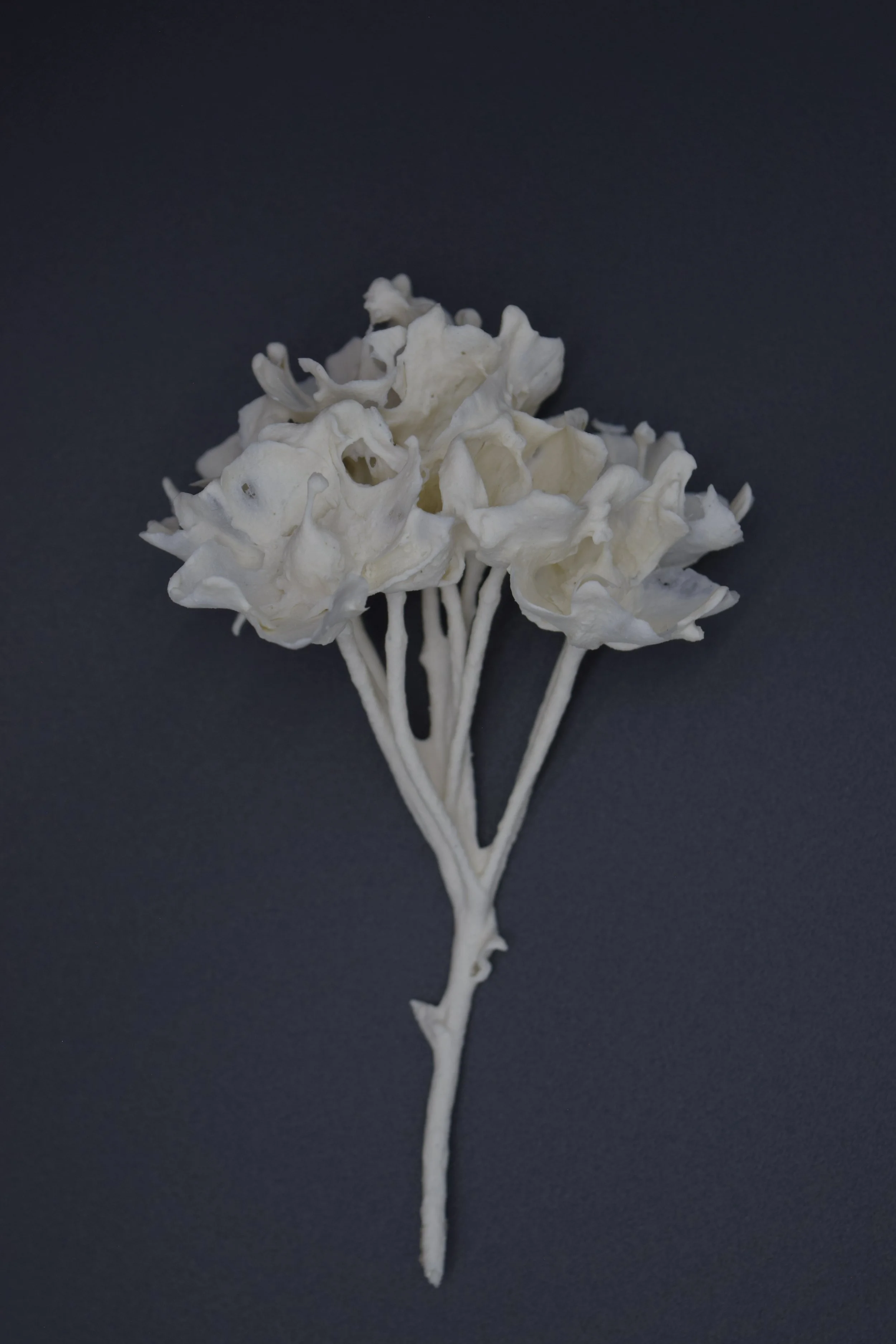
This image returns when I encounter Vivian Zhou's ceramic works. Through the burn-out process, the kiln simultaneously creates and consumes, preserving the delicate forms of plants while destroying the organic material from which they came. Fire is an agent of loss and transformation. The resulting sculptures are not simply representations of botanical forms but also of absence, where what once lived survives only as an imprint. When complete the porcelain surfaces, seams, and breakage lines record vulnerability rather than conceal it, suggesting that fracture is not just failure but evidence of adaptation.
Using both natives and weeds from the artist suburban garden she memorialises the horticultural everyday – the leaves and flowers of the common ‘garden variety’ - nature that is all around us and that exist largely unnoticed. Echoing T. S. Eliot's phrase, these forms lie "like a patient etherised upon a table" Zhou also draws on the language of the gallery and museum display. Objects are carefully staged, isolated, and subjected to scrutiny. Carefully supported they ask viewers to become conscious of care, handling and touch – they have a tactile sensibility that is felt in both the eye and hand and their instability is essential to their meaning. Each object seems between support and failure, where balance depends upon acts of attention rather than permanence.
For me, ceramics is at its most compelling when it operates through simple but profound oppositions: hard and soft, fragile and strong, ephemeral and permanent. Zhou's sculptures inhabit this littoral territory with sensitivity. The alchemical transformation of the kiln is familiar to ceramic practice yet here it becomes a meditation on what remains after contact—after migration, fire, after language and memory begins to fade.
Rather than resisting instability, Zhou embraces it as a condition of living. These sculptures remind us that care is not simply an action but a structure of attention through which fragile things continue to endure.
Glenn Barkley
Glenn Barkley is an artist, writer and curator based in Sydney and the Shoalhaven, NSW.
Tieyuan (Vivian) Zhou has been selected as a finalist for the SALA 2026 The Advertiser Contemporary Art Award.
This exhibition includes works developed and produced with support from the Major Exhibition Award and the Jaquillard Exhibition Award, received at the 2025 Helpmann Academy Graduate Exhibition.