

Cutback by Scott Pyle & Scorched Earth by Anh Tran & Thu Huong (Abigail) Nguyen.
Scott Pyle
Scott Pyle (he/him) is an established South Australian artist whose vibrant painting practice spans more than 17 years. Working from Tutti Arts' Port Adelaide studio, he has developed a distinctive visual language shaped by his enduring interests in pop culture, surf culture, fantasy, monsters, systems, patternmaking and Adelaide's rail history.
Drawing, painting and repetition are central to Pyle's practice. His works transform familiar subjects—from Power Rangers and mythical creatures to train routes and calendars—into energetic compositions filled with bold colour, movement and intricate structure. His unique approach has earned him a dedicated following among collectors and audiences alike.
Pyle has exhibited widely throughout South Australia and nationally, including exhibitions at FELTspace, Greenaway Art Gallery and First Draft (Sydney), as well as the SALA Festival, Adelaide Fringe and OzAsia Festival.
Collaboration has played an important role throughout his career. Long-term creative partnerships with artists including Paul Hoban and Henry Jock Walker have expanded his practice through shared ideas, experimentation and ambitious projects.
Through his work, Pyle invites audiences into imaginative worlds that celebrate curiosity, storytelling and the joy of making art.

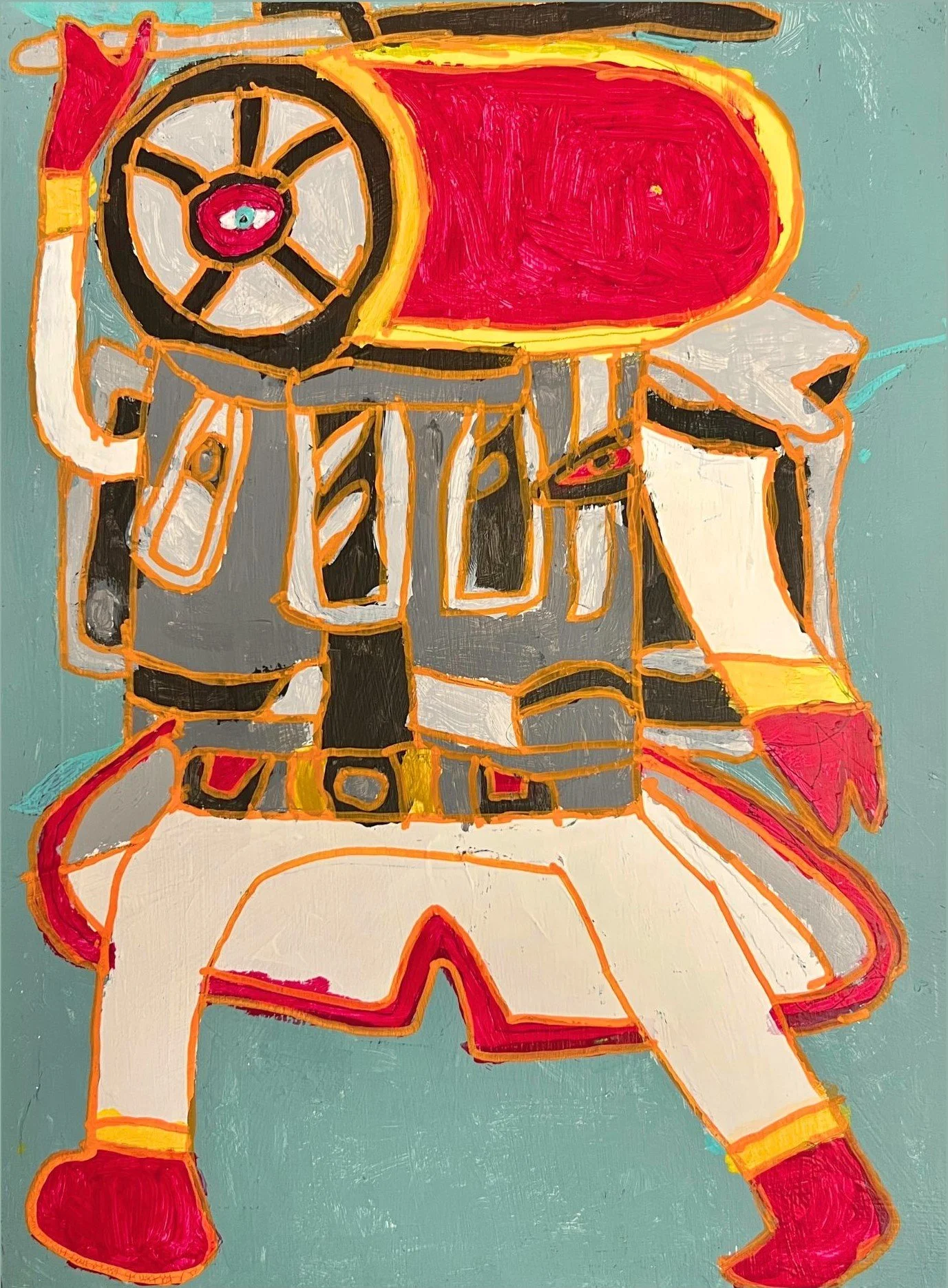
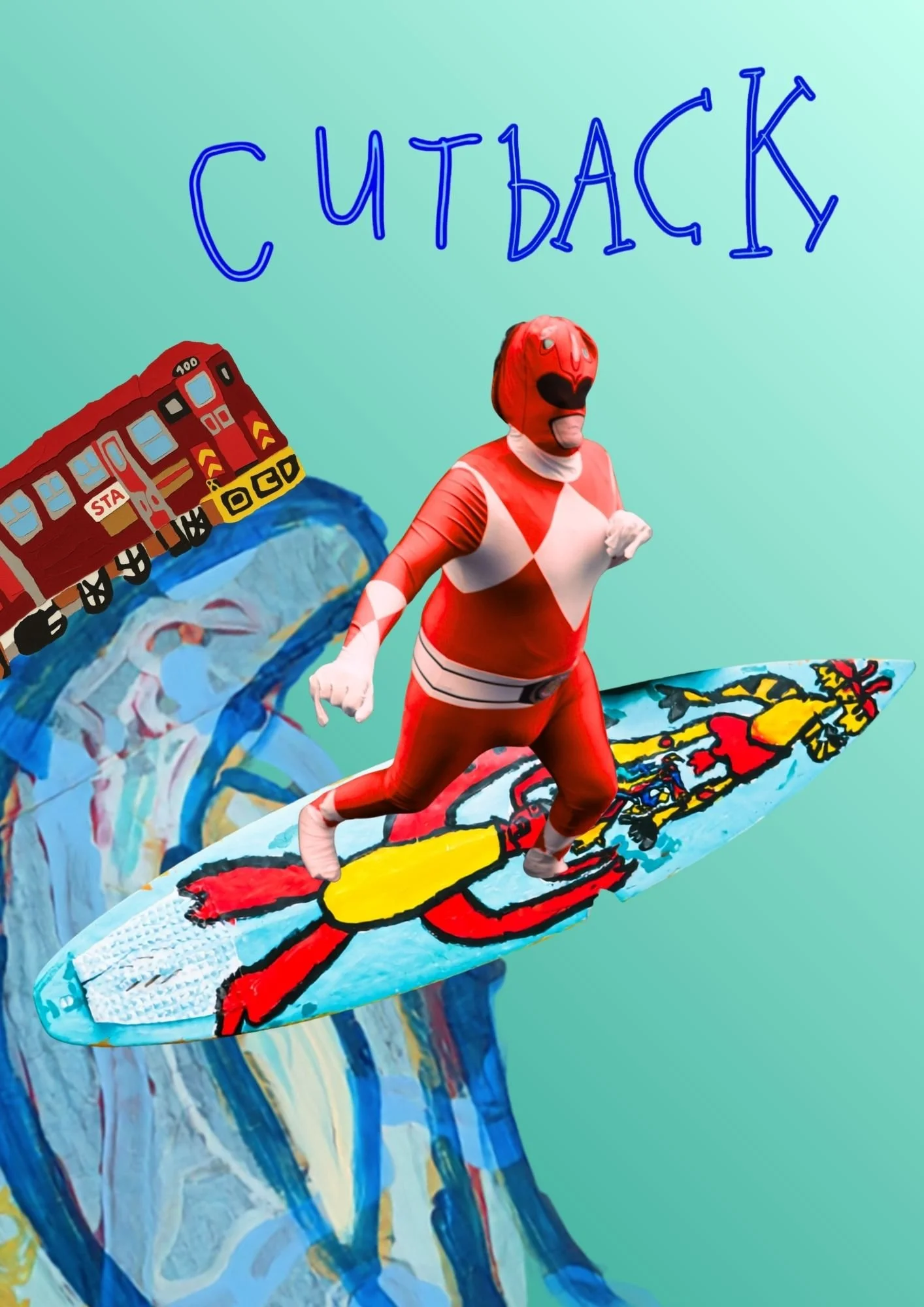
The first time I encountered Scott Pyle’s work was in August of 2013, occupying both the front and back rooms of Felt Space, Adelaide. The exhibition was titled Orange Wrappers – a near-anagram of Power Rangers – one of Scott’s all- time favourite TV shows. // The works from this exhibition that have remained most-branded on the brain of my eyes and that of my heart region are those of the paintings with a high density of Scott’s Power Ranger monster figures populating their surfaces, made in collaboration with another local artist, Paul Hoban. // The overall network of space between Scott’s figures—a more or less intricate, pattern-evading mesh of wobbly-cum-jagged shards—would combine and at times blur the lines with the lines and the shapes that constituted them, working together to move and redirect my eyes in a refreshingly unfiltered and riotous manner. // I imagine being lulled into some sort of waking REM sleep, with dream-visuals of energy and flow, rather than objects and atmospheres. // I imagine what it is like for Scott when he is recalling the name and the appearance of a given Power Ranger monster, along with the season(s) and episode(s) in which that monster appears. // I imagine a diagram representing a vast and entangled network of railway tracks, appearing under the heading: Mighty Morphin Power Rangers Rail Map. // Within this wider network, one can make out different Lines – Season 1. Season 2. Season 3. – each represented with its own colour. // Along each Line there are delineated a sequence of Zones, with each Zone signifying an episode number – Season 1 Line: 60 Zones. Season 2 Line: 52 Zones. Season 3 Line: 33 Zones. // Along each Line, and within each Zone, at varying intervals, there are located one, to any number of, colourless circles, which momentarily break the colour-band of the Line – each representing one or another of the Line’s Stations, with each Station being represented by the name of a given monster. // One may note that certain Station names are repeated within different Zones and along different Lines – this is due to certain monsters making more than one appearance within the episodes that constitute the Mighty Morphin Power Rangers’ overall universe. // I imagine the colourless circles of the Stations as the gaps— the synapses—scattered along the neural pathways of a brain, with each linked synapse conjuring the appearance of a Station as the electrical current passes thru it, with its appearance being that of the monster which corresponds to the Station’s name. // Scatterbrain. Crabby Cabbie. Oysterizer. Two-Headed Parrot. Terror Toad. Robogoat. Octophantom. Commander Crayfish. King Sphinx. Yetiki. Rhinoblaster. Invenusable Flytrap. Chunky Chicken. // Scott’s linework and shapes possess the directness and the urgency of a mind making links, ordering and conjuring a pathway forward, as if the very force of life depended on it, while at the same time this process of transcription, jotting down, delineation, mapping, restoration, archiving towards a here and now being given to occur in the company of an ease that would seem to say: It’s all good mate. We’ll get there. One station at a time.
Tom Squires
Anh Tran & Thu Huong (Abigail) Nguyen
Anh Tran is an artist and transdisciplinary designer based on the lands of the Kulin Nation specialising in digital narrative, filmmaking, VR/XR, immersive exhibitions, and AI. Her practice integrates emerging technologies to explore environmental consciousness, feminism, and multicultural sensitivity. Through immersive experiences, she redefines perceptions of the environment, emphasising non-anthropocentric perspectives. Anh creates works that embrace complexity and uncertainty, fostering ecological awareness and pushing the boundaries of technology and narrative to inspire deeper connections with nature.
Thu Huong (Abigail) Nguyen is a contemporary jeweller, metalsmith, and painter who is currently based in Hanoi, Vietnam. Abigail's works revolve around utilising industrial mechanics and motions to explore themes of technology, body dysmorphia, nostalgia, and the social and economic change of both her country and contemporary society. She is especially interested in mechanising organic images such as those of the human body, animals, and plants to demonstrate the rapid takeover of technology toward human evolution, heritage value, and societal morals. Through the process of merging the old and the new, Thu Huong seeks to reflect on the desire to preserve her country's traditional values and, at the same time, her willingness to embrace the unpredictable future of our ever-changing world.
Anh and Thu Huong collaborate as Vietnamese-born artists whose distinct practices explore speculative narratives through complementary lenses. Anh’s expertise in digital narrative pairs with Thu Huong’s material-driven exploration to create layered works grounded in dialogue, difference, and a shared ambition to reflect on the future while remaining rooted in cultural memory. Their common interest in storytelling, design, and imagined futures brings a unique perspective to the Vietnamese art scene in the Australian contemporary art world.

The war doesn’t end when the soldiers leave, roaring away in helicopters, ignoring the screams and outstretched arms of those down below.
It lives on in bare tracts of land, a country’s literal scars, unable to sustain life. It pushes animals from their homes, never to return, and people from their ancestors, breaking bonds that are impossible to mend.
It is blown into villages and neighbourhoods and swept into rivers, forcing an impossible choice: starvation or poison.
It travels down bloodstreams and umbilical cords, into mothers’ despair and babies’ cries. A lifelong curse - out of sight, out of mind.
It wreaks havoc throughout communities, striking them down, making sure they can’t ever get up again.
It is transmitted through lies and denials, an almost unbelievable ability to look evidence in the eye and say this did not happen or it was not our fault or we apologise.
Though tentative steps are taken towards healing, no amount of money can reverse time, nothing can return the land to the way it was before.
Now, another monster has arrived, rippling with orange skin and animus towards those who don’t look or speak or think like him. Oceans away, him and his men are waging new wars without looking back, creating new monsters and horrors while beating their chests with false bravado.
They don’t seem to care that the war is still here. In the soil, the water, the air; in the veins and the rasping breaths of those left behind.