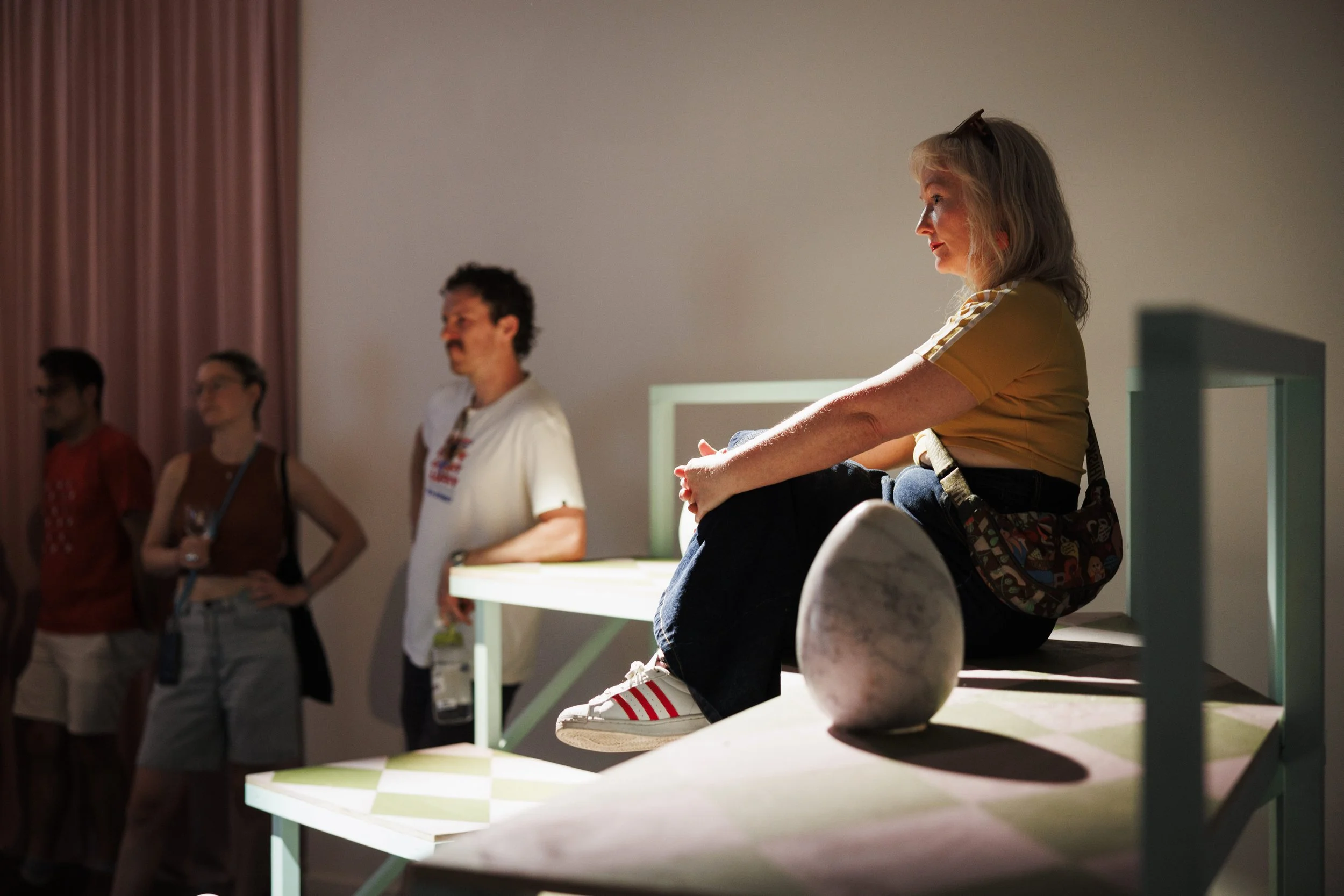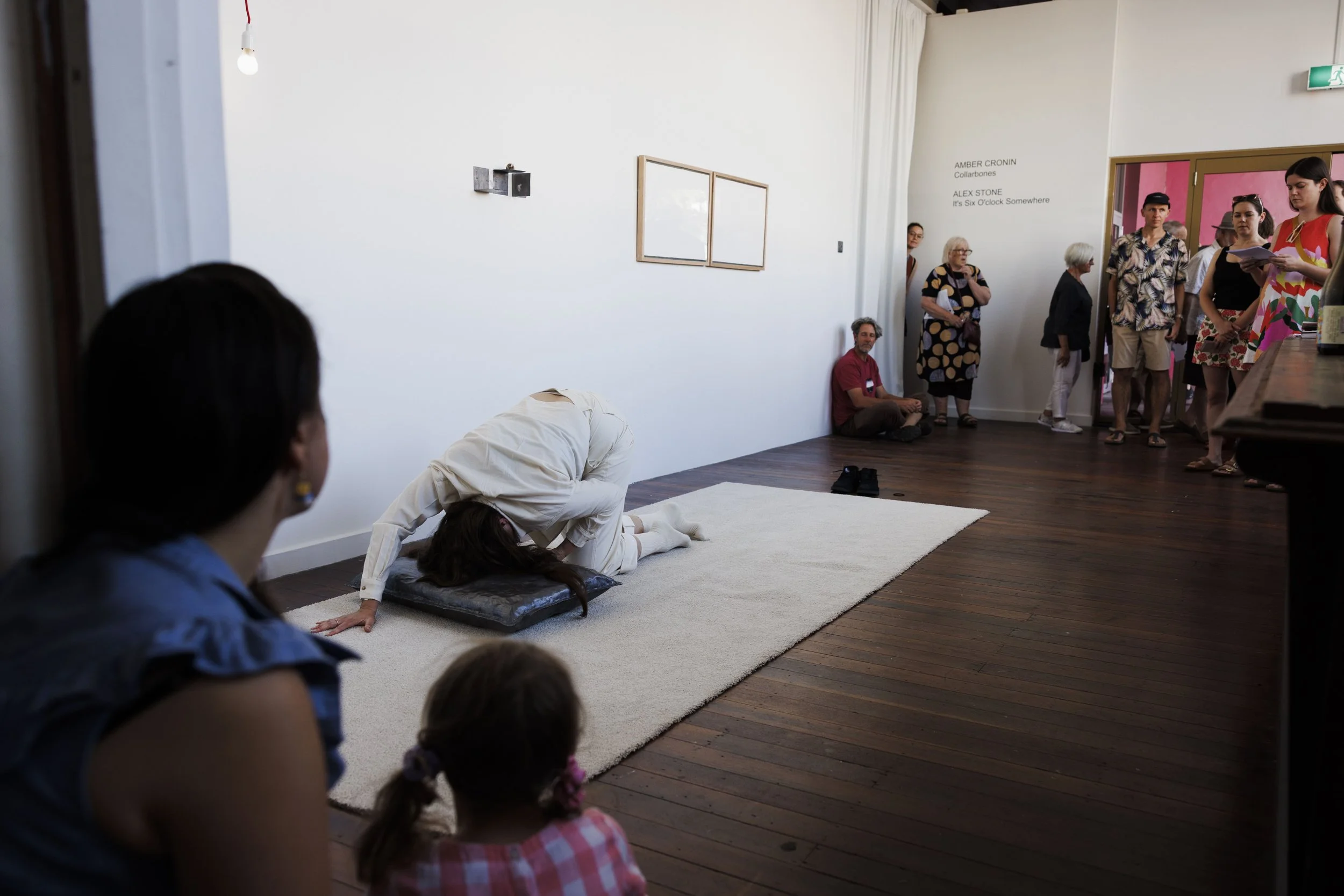
Collarbones by Amber Cronin & It’s Six O’clock Somewhere by Alex Stone.
Amber Cronin
Amber Cronin is a cross-disciplinary artist living and working on Kaurna Yerta (Adelaide, South Australia). Her practice moves between sculpture, textiles, sound, and performance, creating works that gather people, materials, and environments in shared acts of attention and reflection. Situated within an ecology of research that includes plants, soil, language, and the body, her projects explore resilience, ecological grief, and the ways we remain connected during times of transformation.
Developed through extended periods of research and collaboration, Cronin’s work reframes everyday gestures as participatory rituals. Her practice arises from an oscillation between global phenomena and intimate encounters, finding expression in spaces where art becomes both contemplation and survival - a means of staying with the heavy things in order to move forward. Working predominantly with textile processes, she approaches material as a carrier of memory, drawing out quiet narratives held in touch, repetition, and repair.
Her practice operates as an interdependent system of studio making, gallery presentation, facilitation, and community engagement. Alongside her own work, she is a program curator for South Australia’s Nature Festival, where she commissions and produces large-scale public programs exploring art’s role in environmental storytelling. She was a founding Co-Director of The Mill, helping establish one of the state’s key artist-led spaces, and has undertaken research residencies across Europe, including PADA (Portugal) and ISSP (Latvia).

How do we understand the value of a life in the arts? Perhaps through its ephemeral material: photographs and tax returns, flyers and newspaper clippings, costumes frayed and repaired, rehearsal notes and fragments from grant acquittals, public liability insurance renewals. The archive of an artistic career rarely settles as property portfolio or superannuation. It accumulates instead as sediments – layers of paperwork, fabric, memory and intergenerational honouring. As Angela McRobbie has observed, creative workers frequently internalize precarity as passion, accepting instability as the price of autonomy.
Awareness of artistic precarity is not new. In 1973, the Art Workers’ Union was formed in Sydney, making more formal conversations about payment and copyright issues for artists exhibiting in publicly funded galleries. It would merge with the MEAA two decades later, into a landscape with more peak bodies and associations like NAVA making strong representations about artists rights. And attempts to generate policy settings such as centering artists as workers in the national cultural policy and building a Centre for Creative Workplaces to support it. Yet the persistent structural reality remains. For too many artists, a life in the arts is marked by erratic income and long-term insecurity. Interrupted superannuation, delayed medical and dental care, retirement without property ownership. These are not anomalies but patterns.
In Collarbones, cross-disciplinary artist Amber Cronin sifts through the objects, artefacts and stories of their father’s life in the arts through the lens of their own memories and their own deeply connected socially engaged practice that builds care and artistic resonance.
Cronin’s practice makes visible the labour of holding space, the embodied, relational work that sustains culture while rarely providing security for those who produce it. Here precarity is not abstract but intimate, even palpable.
How does one make a life in the arts and how do we record such a life? This exhibition suggests that artistic value endures not as accumulated wealth but as accumulated meaning, carried forward despite uncertainty and held however precariously in community.
To stand on the shoulders of creative forebears is to inherit both their courage and their vulnerability. Each generation of artists enters the field with knowledge of what has been given, and what has been sacrificed. The question is not only how artists survive, but how cultural systems might evolve so that survival is not the measure of success, but rather thriving.
The intergenerational archive assembled here asks us to look beyond the moment of performance to the structures that sustain those who dedicate their lives to cultural labour.
To honour a life in the arts, and by extension the life of all artists, is not only to celebrate the work produced and the archive that tries to recount the making life, but to confront the material conditions supporting - or inhibiting - that work, then and now.
Collarbones is at once show, tribute, and political statement calling for, as academic Mark Banks would have it, creative justice.
Tully Barnett
Associate Professor of Cultural Policy at Adelaide University.
Alex Stone
Alex Stone is an artist working with sculpture, interventions and performance, living in London and regularly visiting their partner in Tarntanya/Adelaide. Originally trained in theatre design, Stone has taken this desire to reimagine and alter spaces, to physically retrace memories and place in an attempt to address notions of absence and to learn from “the fleeting".
In 2024 they completed an MA in Fine Art at City and Guilds of London Art School. Since graduating they have spent a semester as Artist in Residence within the UniSA Contemporary Art Glass workshop and are currently a fellow in Glass and Casting at City and Guilds of London Art School.
They have exhibited work internationally including at: The Photographers Gallery, Open Eye, Photofusion and The Safehouses; UK. IEEC; Barcelona, FELTSpace and Sauerbier House: South Australia.

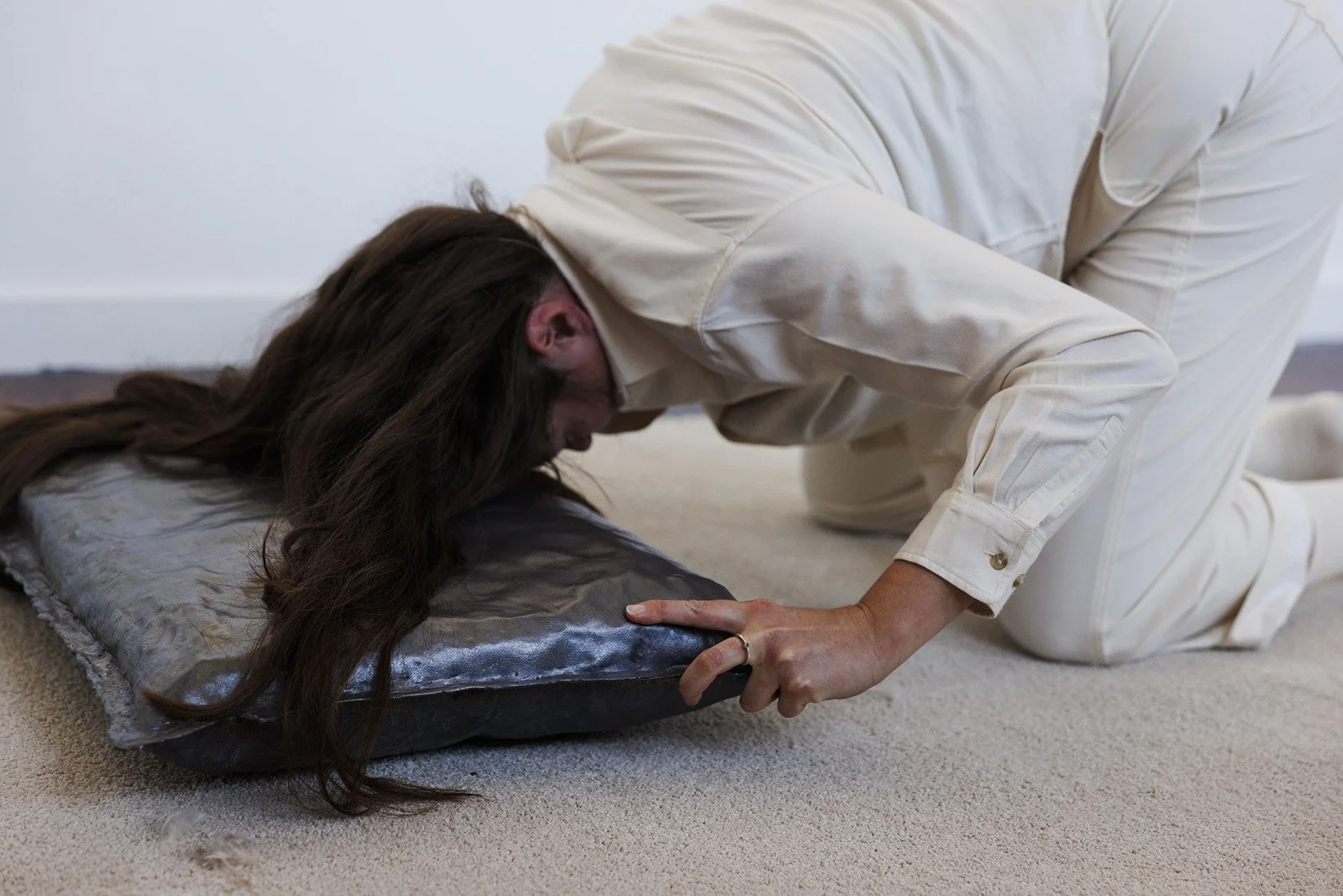
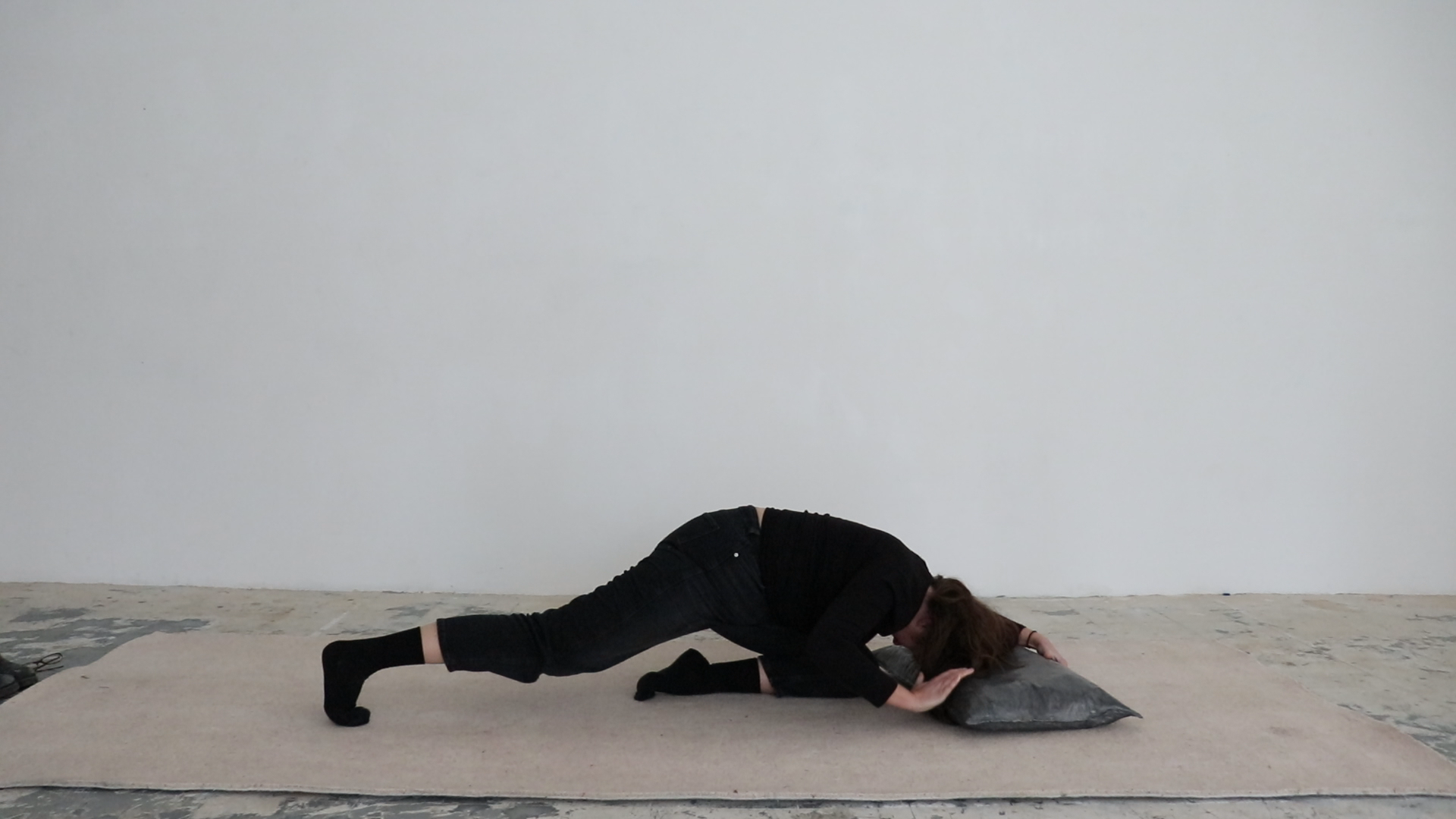
This exhibition comprises: a hollow lead pillow placed on a carpeted area of the floor, the soft metal pressed to capture the design, texture and shape of an actual pillow – welded at the seams, it is stuffed with down, tiny gaps allowing the occasional egress of feathers; a light switch cast in lead and mounted on the wall; an actual light, its bulb hanging low over the pillow; small shelves and boxes made from lead plates; upon and within these rest substances, including soil, feathers, and a hairball (crafted from the artist’s own hair); two framed prints, these made by pressing the artist’s parents’ pillows with paper, so it has embossed into it the folds of the fabric, and has absorbed the parents’ night-time bodily effusions, sweat, oils and saliva; and a video monitor showing a performance in which Stone kneels, presses their head to the lead pillow, hair cascading over it, and slowly and laboriously pushes it across the carpet.
The installation recalls the layout of a bedroom. Ask yourself, what kind of person would occupy such a space? It suggests, to me at least, someone riven by grief, insomnia, boredom, depression, loneliness, self-disgust. The emotional register is that of anxiety dreams and dreams of falling. These feelings are sharpened and get a kind of redemption from sentimentality through spare forms, careful attention to materials, and exacting process. Lead is heavy, malleable, toxic. We recognise these qualities in its dark lustre, and they play a role in the installation’s emotional force. For Stone, the hairball evokes a choking sensation, a horror – an impulse to “scream”, while “unable to scream”, they say. Adelaide audiences might see an affinity between Stone’s work and the emotional tenor of Michelle Nikou’s cast spoons and John Barbour’s heart sculptures, which he folded and shaped haphazardly and lovingly from lead sheet.
Casting and imprinting have a broader life in current art in Adelaide, but these practices sometimes look to be on a trajectory to the gift shop. Stone, like Nikou and Barbour, has sought a larger frame of reference that lets in grime and the dark spectrum of negative emotions. That comes, in part, from the kind of sanction and example given by artists like Rachel Whiteread, Joseph Beuys, Felix Gonzalez-Torres and others, as well as some of the articulations of queer aesthetics. Although such larger frames of reference have faded from attention here, they seem to me a wholly positive thing, binding us into aesthetic and artistic ambitions beyond the local.
It’s Six O’clock Somewhere: the refrain of alcoholics and other assorted early drinkers. For Stone the phrase recalls their own sense of physical and emotional displacement between London and Kaurna Yerta / Adelaide, between them and their partner. It’s something I’ve experienced too, but struggle to articulate, in contrast to Stone. Stone has made another lead pillow, a companion to this one. It is in London, and the video of the performance, in which we see this second pillow, was made there. So, this work has another divided, placeless quality to it, occupying a permanent, unsettled twilight, that illuminates and animates the emotional darkness.
Michael Newall
Writer and philosopher working in Kaurna Yerta / Adelaide.
The Little Machine: Space for Contemporary Art Co-Director.