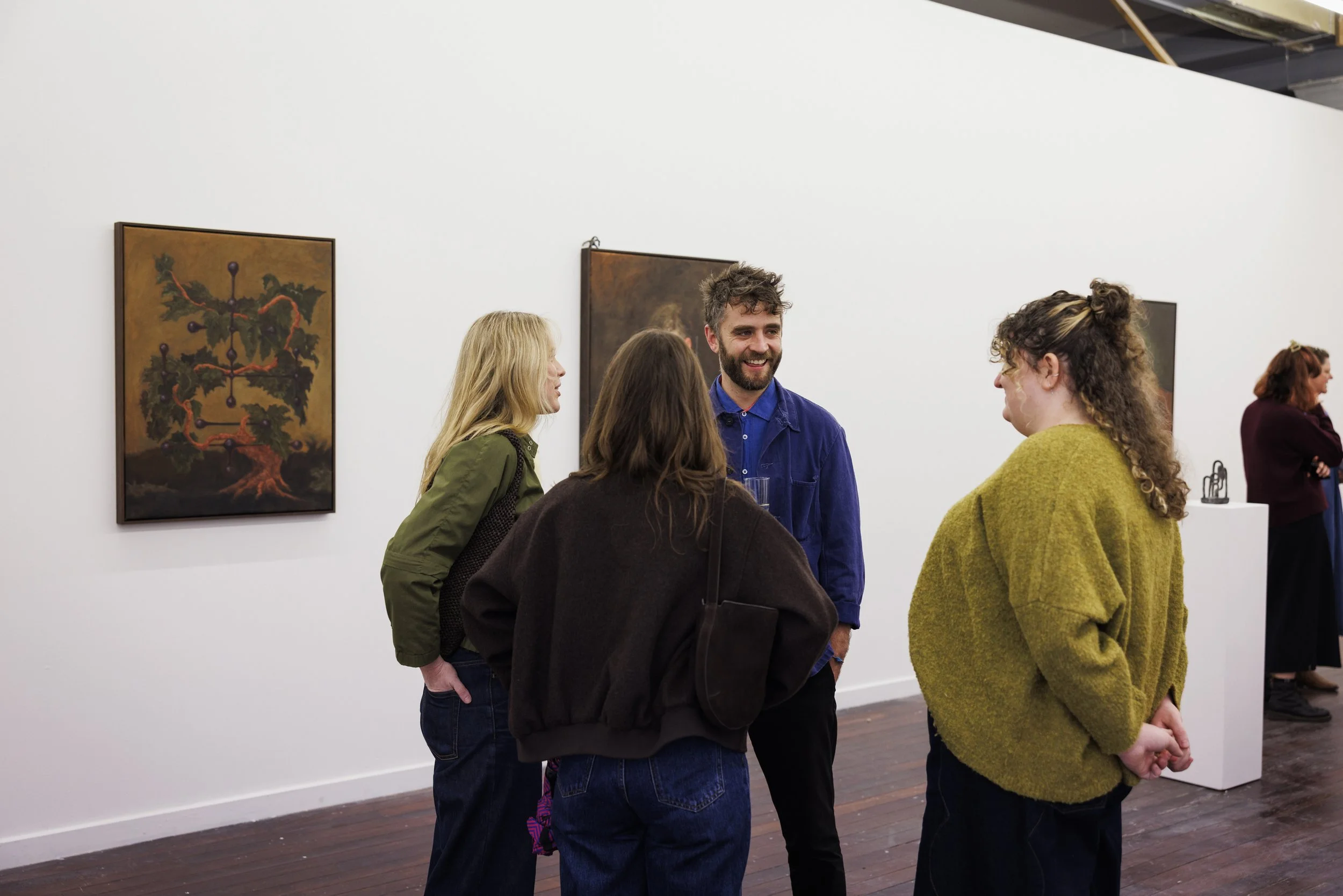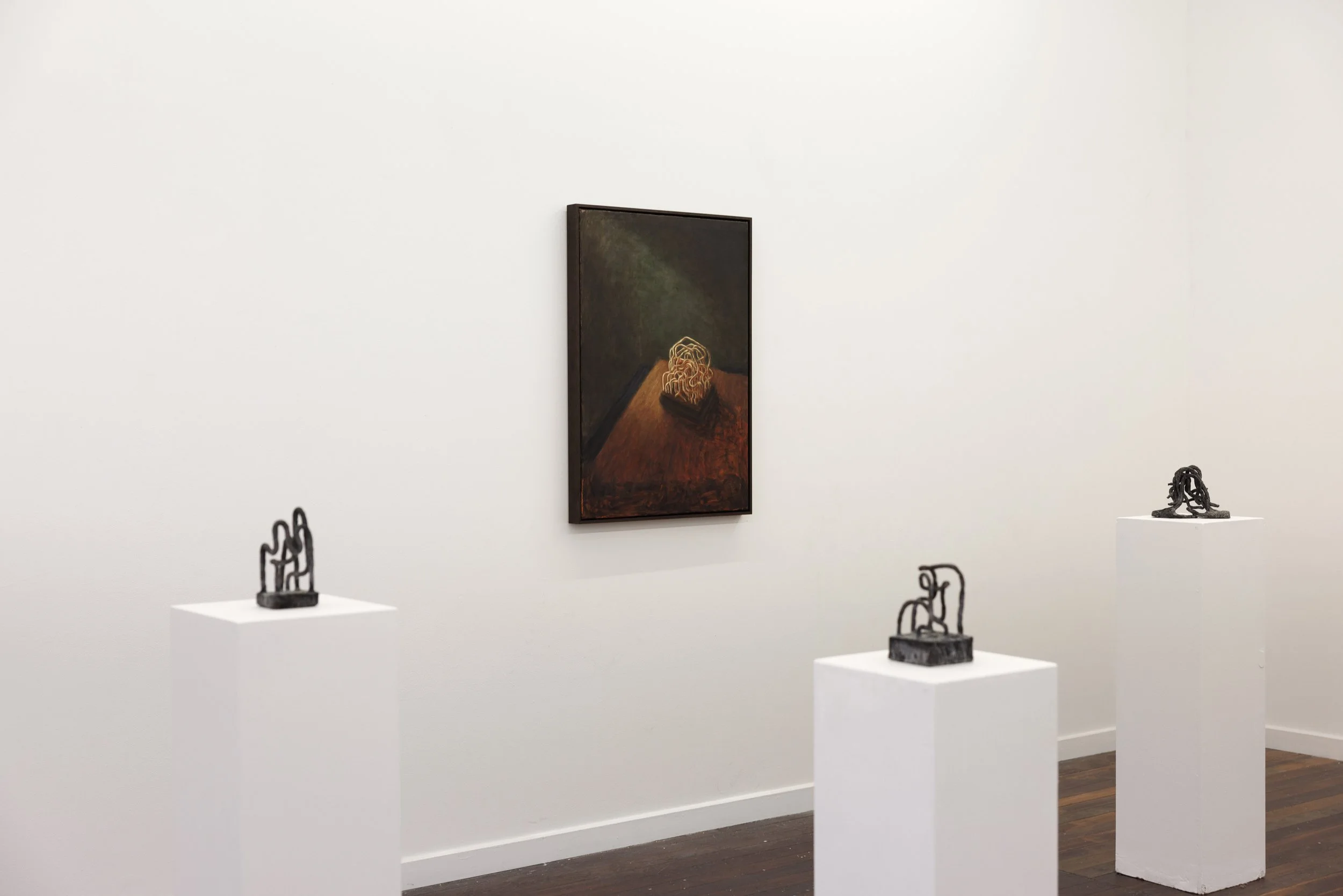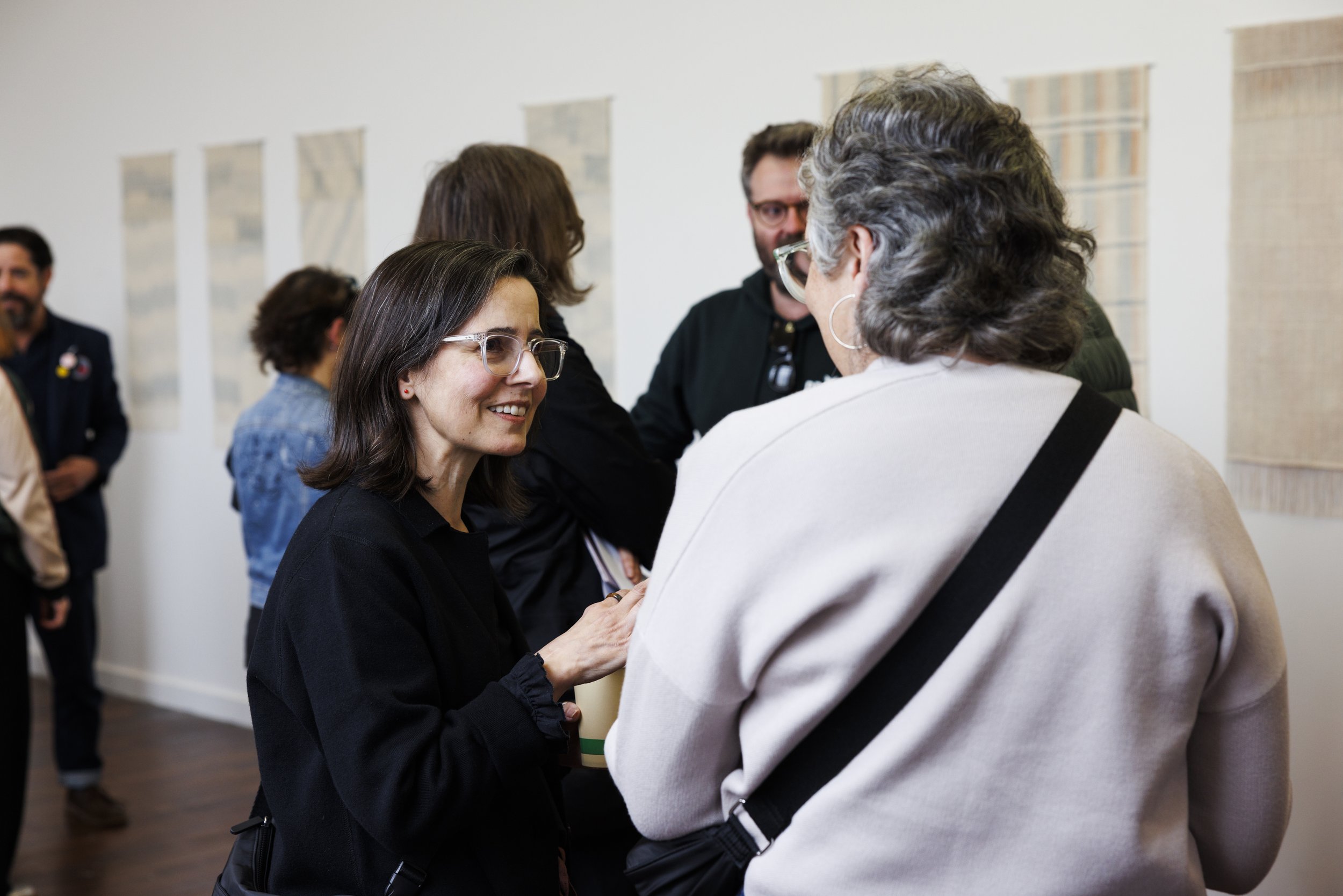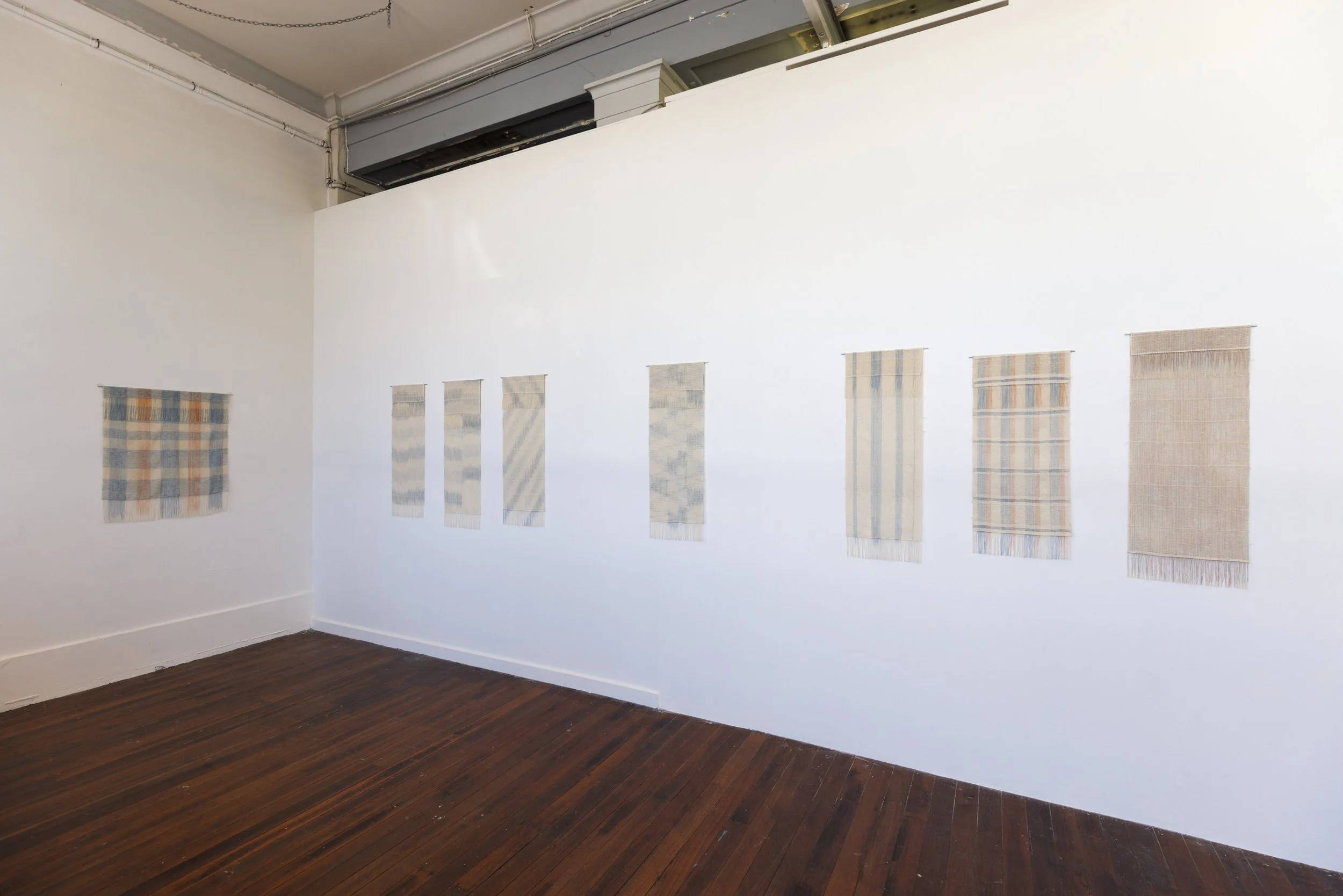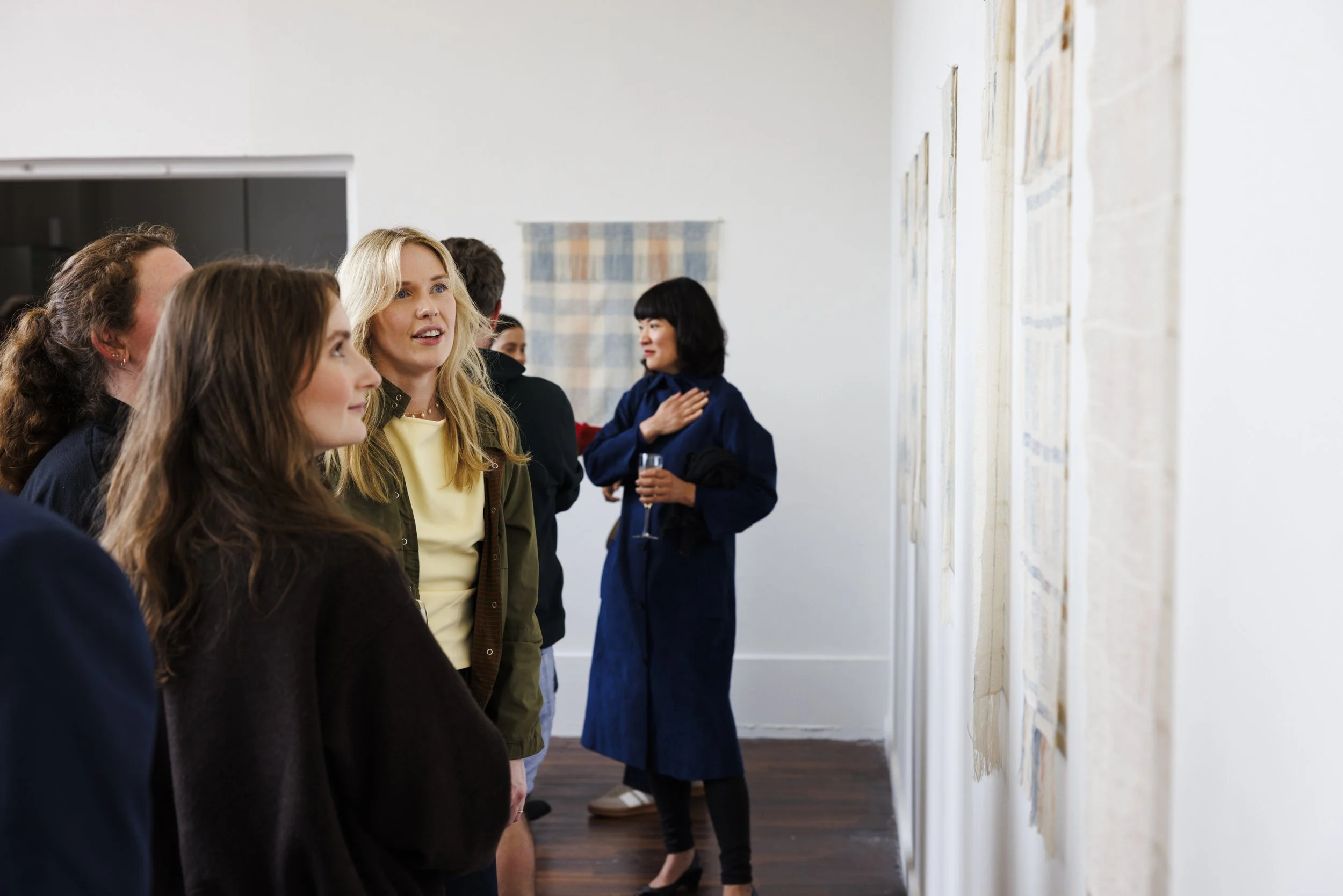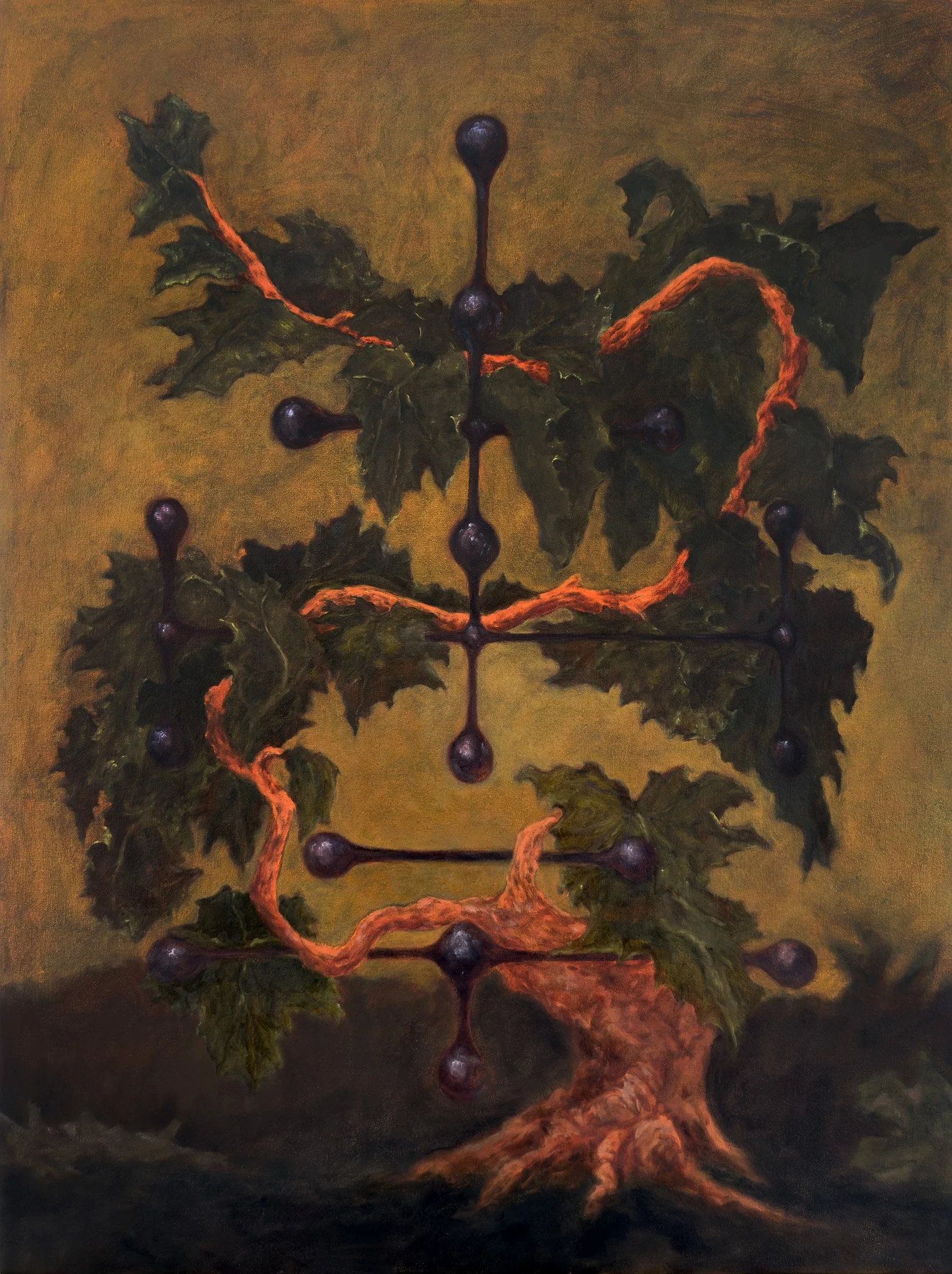
International Hotel by Nicholas Hanisch & un/re weave by Lucia Dohrmann.
Nicholas Hanisch
Nicholas Hanisch is a multidisciplinary painter and sculptural artist based in Adelaide. He is interested in a blurring of time. His sculptures and paintings playfully recreate creation narratives while blurring contemporary and historical references. Absurdity, humour, failure and happenstance are central to his studio practice. Previously Hanisch has attended the New York Studio School, practised and exhibited in Berlin, participated in residencies across India, and graduated with First Class Honours as a scholarship recipient at Adelaide Central School of Art, as well as being selected for the 2021 National Graduate Exhibition at the Perth Institute of Contemporary Arts.

The Messenger
As the aircraft’s super-heated exhaust exited the rear of two huge jet engines and made contact with thin and frozen high-altitude air it vaporised instantly and from the ground the tiny point and its long, fading tail traced the sky like some silent and wayward messenger from the far reaches.
Klaus squinted at the scored atmosphere and wondered whether the omen would bring good or bad luck. Whether a bomb dropped from that height would offer those on the ground any time to say their farewells. Bad luck, then.
He wasn’t altogether a bitter man; he was tired, worn out… he had lost faith in the future - that was certainly true - and his conversations with others would quickly and inevitably slip into a deep, chasmic pessimism.
He didn’t mean to funnel all communication to those depths, but the weight he felt each morning as he tuned in to global goings on preordained his interaction with the city’s other inhabitants. He believed his species had peaked and was now busy only in its pursuit to hasten its demise.
Passing through the small driveway and crossing the asphalted courtyard to his workshop, Klaus stopped and gently ran the back of his fingers along the length of an equally aged cat, which arched and purred and pressed into the old man’s hand - the cat’s vertebrae locking into his bony knuckles like teeth on the cogs animating some dormant machine.
Inside his studio, he considered the large and smoothed piece of granite that he’d collected years back on a trip to Denmark and which now sat, content, he believed, on a roughly-hewn bench. Its surface, although rounded, was covered in what reminded Klaus of scars on whale skin, but were likely gouged by glacial motion when the rock was already ancient.
A skylight above glowed a warm and perfectly monochrome blue. No gradient or shift in colour. No clouds even. Occasionally the tip of a branch swayed into frame and its plump green leaves threw spotty shadows across the wall and the forms stretched as they danced further from the opening through which they came. The leaves, as if cast from the heavens to glow as earthly echoes of a creator, proudly revealed the veins structuring their gloriously translucent membranes. That green against the blue sky. God this is a beautiful city in summer, Klaus thought.
Harry Thring
Australian artist currently based in Hamburg, Germany
Lucia Dohrmann
Lucia Dohrmann is an early career artist living and working in Adelaide/Tarndanya, graduating from Adelaide Central School of Art with a Bachelor of Visual Art (Honours) in 2017. Lucia’s practice centres on the intersections between pattern and repetition, textile processes and mathematics, within the fields of painting and textiles. Simple geometric forms that often feature in her works, such as grids and circles, are closely associated with these systems of order. Lucia’s work primarily focuses on the materials used and the time-intensive processes of unpicking and reconstructing that she employs. Her works make visible the materiality and physical construction of her chosen grounds, painters’ canvas and discarded clothing: pliable grids of woven threads. It is the handmade quality and painstaking processes that help the works to achieve a softness and warmth and evoke an emotional sensibility that is reflected back to the viewer. Lucia’s work is held in a number of private collections, and has been exhibited nationally in solo and group exhibitions. Selected solo exhibitions include ‘Visible Silence’, West Gallery Thebarton, Adelaide, 2020; and selected group exhibitions include ‘Pliable Planes’, UNSW Galleries, Sydney, 2022 and ‘Radical Textiles’, Art Gallery of South Australia, Adelaide, 2025.

A blank canvas has no defined preconditions. It accepts any colour and design bestowed upon it. Intricate figure studies, abstract linear designs, serene still-lives, flamboyant colours, or moody monotones. It reflects what it receives.
Our lives are our canvases. We absorb and reflect what has been bestowed upon us. Childhood experiences, cultural heritage, physical attributes, intellectual abilities, and domestic life. We are the canvas; life is the painter.
Lucia Dohrmann’s life canvas reflected her Italian immigrant heritage, her parents’ creative artisan make-do-and mend attitude, her math aptitude leading to a sensible business career, and her role as a doting mother and wife. Happy, loved, colourful, yet linear, safe, and predictable.
As a later-in-life full-time art student, Lucia slowly started unravelling (un/weave) her medium-sized, tautly stretched, well-painted life canvas. Pulling the threads out one by one. Solid blocks of colour became fragile threads. Some steeped in dark hues, some pure and white, most of them variegated, ombre, and nuanced.
With careful examination, contemplation, and assessment, Lucia organised her threads in a new order and slowly started to construct (re/weave) a new canvas. Using a loom, she chose a few strong and undisputed warp threads – family, heritage, craft, and love – to carry the softer, ever-evolving, and nuanced weft threads of daily life.
This time, her canvas is soft, pliable, open-weaved, and tactile. Unlike the stiff and impervious painter’s canvas, this one is meant to hold, hug, wrap, and cuddle up with. The colours are muted, soft, still distinctly linear, but with soft edges and subtle gradients.
Her Italian heritage is reflected in the muted tones of old Rome; her parents’ artisan craft and trade skills are reflected in the labour intensive and painstaking act of weaving; her mathematical and analytical mind is reflected in the thoughtful intentional patterns and sequences of her designs; her role as mother and wife is reflected in the subtle and tactile references to domestic textiles – checkered tablecloths, upholstered soft furnishing, and candy-striped bedsheets.
Lucia Dohrmann’s well-defined, mindfully constructed woven canvases reflect the abundance that life has bestowed upon her.
Ansie van der Walt
Textile writer focused on cultural textiles and textiles in fine art.